Reading this history: The Han-dynasty origin, Great Wall financing and carrier-pigeon delivery stories are traditions repeated in accounts of keno. This article does not identify primary evidence establishing those details, so they should be read as unverified origin stories.
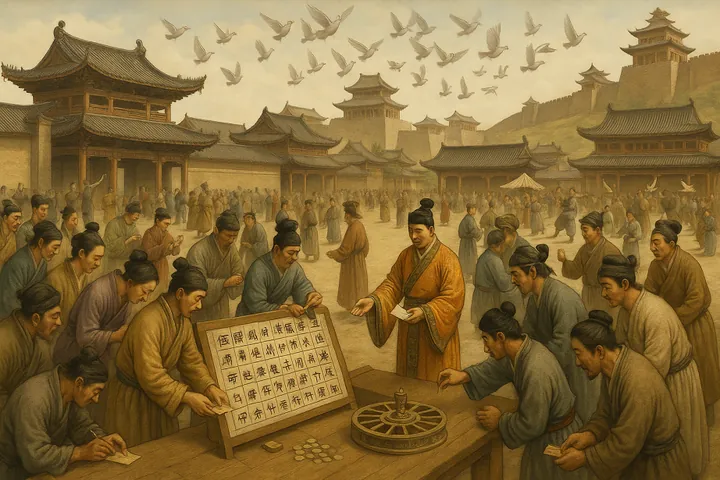
The White Pigeon Game, or báigē piào (白鴿票), is associated with Chinese lottery traditions in histories of keno. To understand the comparison, separate the selection-and-draw mechanic from claims about exactly when, where and why a particular lottery began.
The lottery mechanic
A player selects entries from a larger set and compares those choices with a draw. This gives us a useful comparison with modern keno. It does not, by itself, establish identical entry pools, draw sizes, payouts or rules across different periods.
The imperial origin story
A frequently repeated account says an ancient lottery paid for construction of the Great Wall. The earlier version of this article stated that story as fact without citing a contemporary record. A persuasive historical account would need to identify the dated record, the lottery it describes and the construction project concerned.
Likewise, an account linking a game to the Thousand Character Classic needs to establish the date of the text’s use in that game. A familiar story is not a substitute for that chronological evidence.
Why “White Pigeon”?
The name is often explained through a story about pigeons carrying results. That explanation should remain qualified until an identifiable source establishes the practice, its place and its period. A translated name alone cannot prove a nationwide ancient communication system.
Compare the games without assuming identical rules
For a meaningful comparison with keno, ask how many entries players could choose, how many were drawn and how matches were rewarded. These are testable rule questions. Our history of keno provides a related account; its early-origin stories should be assessed with the same distinction between documentation and tradition.