Picture a roaring crowd, a heavy rubber ball moving with deadly speed, and two teams competing on a stone court where the stakes were often far higher than simple victory or defeat. This was Ōllamaliztli, the ancient Mesoamerican ball game. Played for over 3,000 years by great civilizations including the Olmecs, Maya, and Aztecs, this was no mere sport. It was a deeply complex cultural event, interwoven with politics, religion, and the fate of the cosmos itself.
The Court and the Ball: The Arena of the Gods
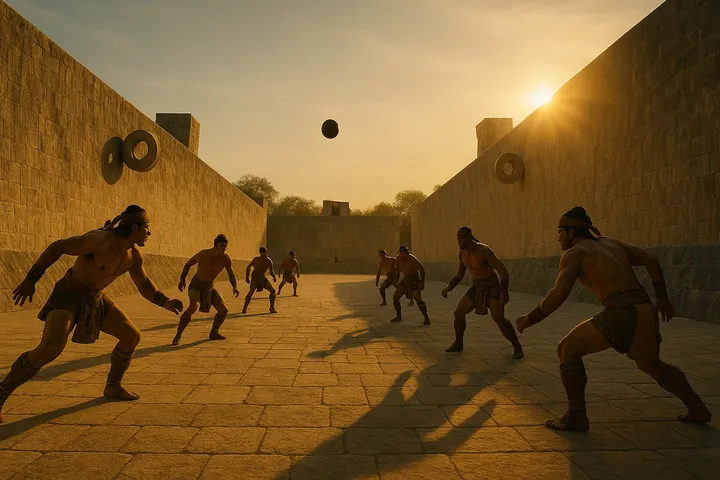
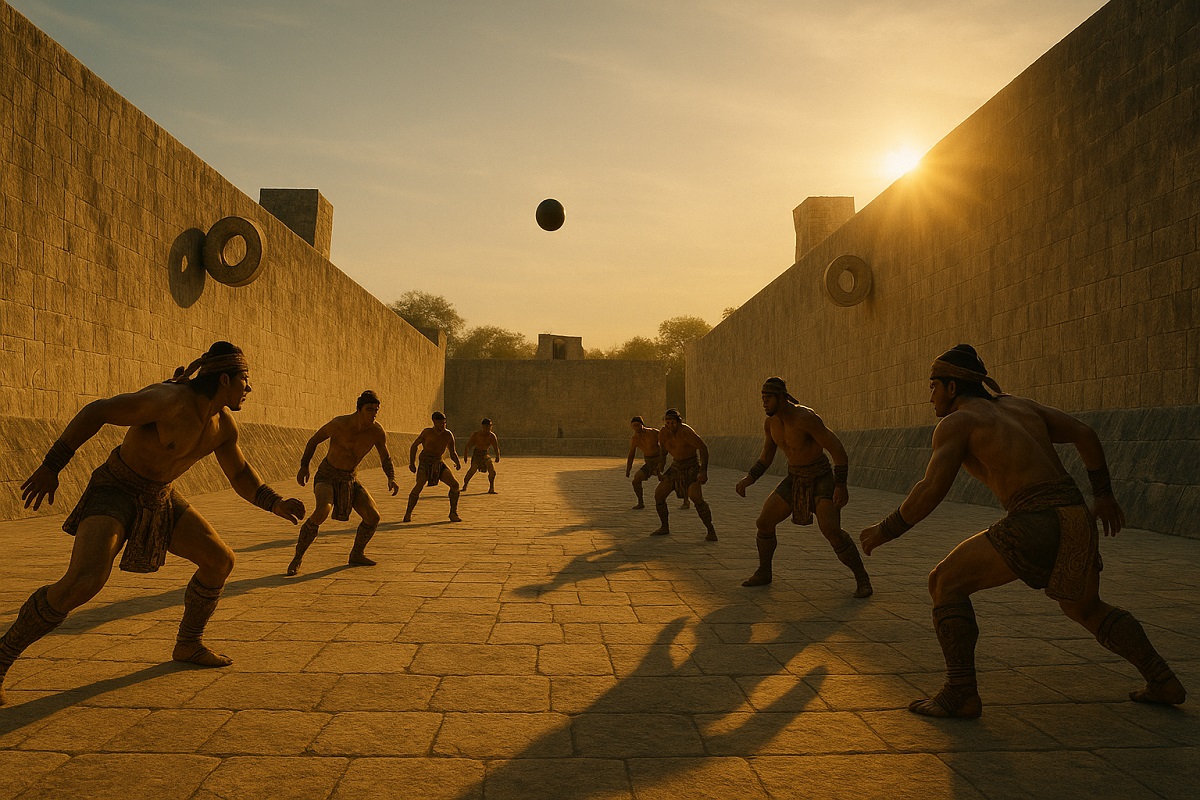
The game took place in a purpose-built stone arena (tlachtli) that has become an icon of Mesoamerican architecture. This was typically a long, narrow alley flanked by high, sloping or vertical walls. In later versions, high stone rings or hoops were set vertically into the walls, serving as the game’s most challenging target.
The ball itself (ulli) was a marvel of ancient technology. Made from solid rubber harvested from local trees, it could weigh up to 4 kg (9 lbs) or more. It was heavy, bounced unpredictably, and could cause serious injury. To protect themselves, players wore elaborate gear, including thick leather loincloths and padding for their hips and knees (yokes and palmas), and sometimes even helmets. This was a full-contact, high-impact game that required incredible strength and skill.
The Rules of a Deadly Game
While the exact rules varied across the many cultures and centuries it was played, the core principles of Ōllamaliztli have been pieced together by historians. The game was a team sport, with the primary objective of keeping the heavy ball in constant motion.
The most challenging rule was that players could not use their hands or feet to strike the ball. It had to be propelled by the hips, thighs, and sometimes the upper arms or head. This required immense dexterity and power.
Points were scored in several ways, often by striking markers or by forcing the opposing team to let the ball hit the ground. The ultimate achievement, however, was to drive the ball through one of the high stone hoops. This was an incredibly rare and difficult feat, and in many traditions, scoring such a goal would immediately end the game and bring immense glory to the player who achieved it.
More Than a Game: Ritual, Politics, and Sacrifice
To understand the ball game is to understand that it was never just about the score. Its true significance was deeply spiritual and political.
- Cosmic Significance: The ball court was seen as a threshold between the earthly world and the supernatural realms. The game itself was a re-enactment of cosmic battles from creation myths, such as the struggle between the hero twins and the lords of the underworld in the Mayan Popol Vuh. The movement of the ball was thought to mirror the path of the sun, moon, and stars.
- Political Tool: The game was a form of proxy warfare. Rival kings would often play against one another to settle territorial disputes, demand tribute, or resolve conflicts without resorting to a full-scale war. A victory on the court was a demonstration of divine favor and political power.
- The Ultimate Price: The game’s most notorious aspect is its connection to human sacrifice. While not every game ended this way, it was a central part of its ritual dimension. In many documented cases, the captain of the losing team - or sometimes, paradoxically, the victorious captain, as this was seen as the ultimate honor - was decapitated. This act was believed to appease the gods, ensure agricultural fertility, and maintain the cosmic balance that kept the world in motion.
The Enduring Legacy
Ōllamaliztli was a central pillar of Mesoamerican life for millennia. It stands as a powerful reminder that for some ancient cultures, games were not a distraction from life but a fundamental expression of it. Today, a modern version of the game, Ulama, is still played in a few communities in Mexico, а living, breathing link to this incredible and brutal ancient tradition.
The Mesoamerican Ball Game: Frequently Asked Questions
What is the Ulama game?
Ulama is the surviving modern form of the ancient Mesoamerican ball game, played for over 3,000 years across what is now Mexico and Central America. Players use their hips (in the most common variant) to strike a heavy rubber ball, with the goal of keeping it in play within a stone court. The game had deep religious and political significance for the Olmec, Maya, Aztec, and other civilisations.
How old is the Mesoamerican ball game?
The earliest evidence dates to around 1650 BCE at the Olmec site of Paso de la Amada - making it one of the oldest organised team sports in the world. Rubber balls and ball-court architecture spread across Mesoamerica over the following millennia, with regional variants persisting until the Spanish conquest.
Were players really sacrificed?
Sometimes, yes - but the picture is more nuanced than popular accounts suggest. Surviving Maya and Aztec depictions show losing captains being decapitated in ritual contexts, but most ball games were ordinary athletic contests without sacrifice. The ritual matches were exceptional, often tied to political settlements or religious cycles.
How did the ball game work?
Two teams competed on an I-shaped stone court, with sloped or vertical walls. The heavy rubber ball - sometimes weighing 4 kg - could not touch the ground or be played with the hands or feet. Players struck it with their hips (most variants), forearms, or rackets. Scoring varied by region: keeping the ball in play earned points; in late Aztec versions, putting the ball through a stone ring above the court was an instant win.
Is Ulama still played today?
Yes - Ulama survives in Sinaloa, Mexico, played by a small but determined community of practitioners using the traditional hip-strike rules. Mexican cultural authorities have recognised the game as Intangible Cultural Heritage. There are active efforts to teach it to younger generations and document its surviving regional variants.
What was the rubber ball made of?
Solid latex, harvested from the Castilla elastica tree and processed with juice from the morning glory vine - a chemistry the Mesoamericans developed long before the rest of the world knew rubber existed. The resulting balls were extremely dense and hard, capable of causing serious injury. Pre-Columbian rubber balls have been found in archaeological contexts dating to around 1600 BCE.