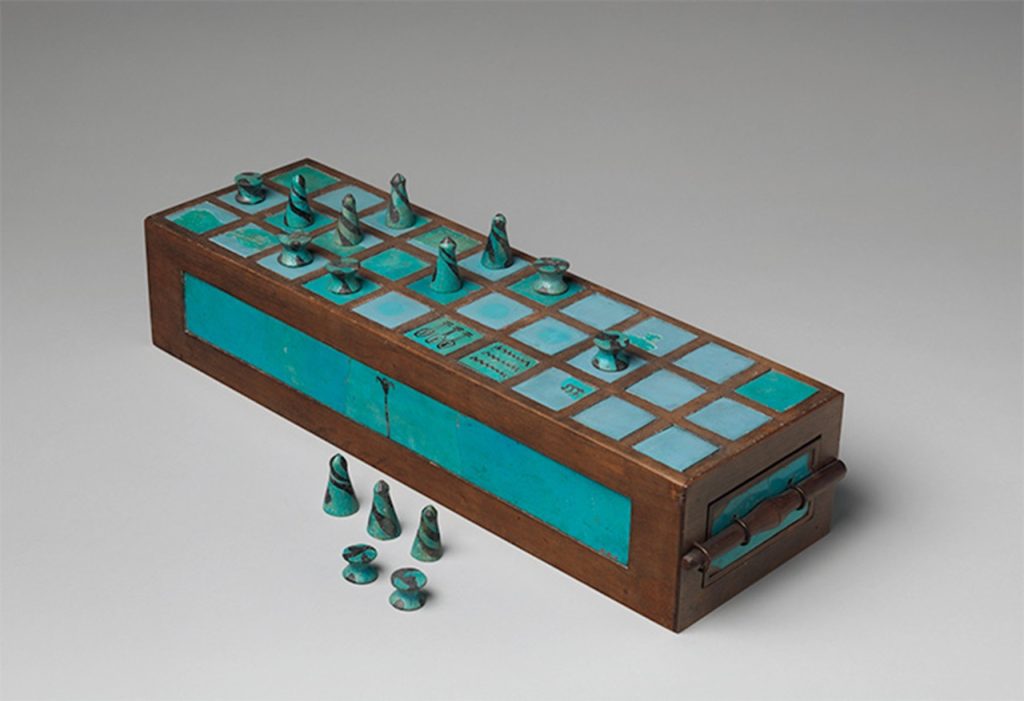

Two different experiences on this page. The browser activity below is a simplified one-piece race inspired by Senet, with equally likely scores from 1 to 5. It does not simulate throwing sticks, blocking or special squares. The historical discussion and multi-piece reconstruction that follow describe different rules; they are not instructions for this activity.
Click 'Roll Dice' to start!
Game Rules
Senet – Ancient Egyptian Game
Race to position 30 to win!
- Roll dice (1-5) to move forward
- First to reach position 30 wins
- Moves beyond 30 are invalid
- Light piece = You, Dark piece = AI
Senet is an Egyptian game, and is one of the oldest games in the world, with records dating back to the 1st Dynasty, around 3100 BCE. Many Senet game boards have been found in various Egyptian tombs, including in the Tomb of Tutankhamun. Senet has not only been played in Egypt, but also in other countries of the Levant and the Mediterranean, such as Israel, Lebanon, and Cyprus, where boards have been found.
Senet is usually reconstructed as a race in which each player tries to move all their pieces off the board. No complete ancient rulebook survives. Modern reconstructions draw on boards, images and written references, but differ in movement, protection and special squares. A reconstruction’s playability cannot by itself prove that its rules were used in antiquity.
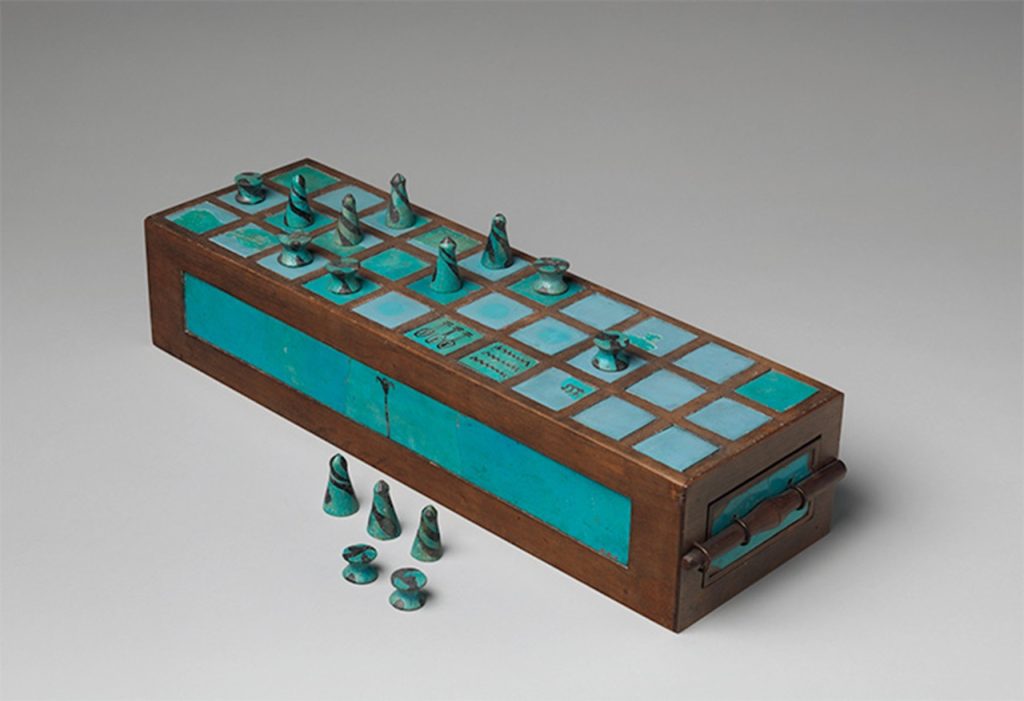
The rules below describe a modern reconstruction attributed to Dmitriy Skiryuk (Дмитрий Скирюк), with editorial clarifications. They use multiple pieces and special squares. They are a separate reconstruction, not the rules implemented by the simplified browser activity above.
What happens in the final houses?
Choose a marked square, then a stick score. Follow the piece’s destination and compare its chance of leaving the board.
Path: first row →, second row ←, third row →. Marked squares are the special houses.
Four fair, independent sticks: score 1 has 4 of 16 possible arrangements (25%). All rounded sides score 5.
House of Beauty
Every piece must stop here. Arrival grants an extra throw; a 5 takes the piece off the board.
Move to the House of Water, which grants another throw.
Chances above use all five possible scores of the fair-stick model. They describe one throw, not the chance of winning a game.
Rules and limits of this example
This follows the Skiryuk reconstruction described below, not the simplified browser game above. It isolates one piece on an otherwise empty board. Occupied-square, blocking and full-turn interactions are in the complete rules.
For squares 26–29, select the extra throw granted on arrival. For square 30, select the following turn’s throw. Square 15 shows ordinary forward movement along a clear path. The fair-stick probabilities are a teaching assumption, not measurements of ancient sticks.
Dmitriy Skiryuk’s reconstruction — a separate multi-piece ruleset
- Players
- 2
- Board
- 30 squares
- Pieces
- 5 per player
- Throw
- 4 sticks
Goal: The player who moves all of their 5 pieces off the board first wins the game.
Set up the board
The game includes a board of 30 squares arranged into 3 rows of 10, 5 conoid pieces, 5 round spindle pieces, and 4, two-sided, throwing sticks are included in the game to serve as dice, with one side rounded and the other side flat.
The pieces get arranged on the first row in alternating cells, with the conoid pieces taking up cells: 1, 3, 5, 7, 9, and the spindle pieces taking up cells: 2, 4, 6, 8, 10.
The movement across the board starts from cells 1-10 and continues along the path until all pieces exit off the board from cell 30.
Read the throwing sticks
Throw all four sticks together. The all-rounded result scores 5, the maximum.
| Flat sides | Rounded sides | Score | Extra turn |
|---|---|---|---|
| 1 | 3 | 1 | Yes |
| 2 | 2 | 2 | No |
| 3 | 1 | 3 | No |
| 4 | 0 | 4 | Yes |
| 0 | 4 | 5 | Yes |
Who starts, and how does a turn work?
To determine which player starts the game, both players throw the sticks. Whoever scores 1 first gets to play with the spindle pieces and moves first.
The player who gets the first move throws the sticks again to determine how many cells they will move.
Make one initial throw. Take an additional throw only when an extra-turn rule below explicitly grants one.
If the player scores 2 or 3 they get only one turn. If the player scores 1, 4, or 5 they get a second turn.
Each score of the dice determines how many cells the player moves from 1 to 5.
A player can choose to move any of their pieces on any move, as long as the move is allowed.
Move, block and swap
Moving past pieces and landing on an occupied square
No cell is ever allowed to have two pieces in it.
A piece can pass opponent’s pieces as long as it is a single piece in a row (i.e. an adjacent cell is not occupied by another opponent’s piece).
A piece can pass its own pieces no matter how many there are placed in a row.
If a piece lands on a cell which is occupied by an opponent’s piece then that piece gets knocked out of that cell and goes back to the cell from where the player’s piece that knocked it out came from.
If a cell is occupied by the same player’s another piece, they cannot move a second piece into the same cell. That cell remains occupied until the original piece is removed from it.
Protected pairs and groups of three or more
If two adjacent cells are occupied by the same player’s pieces they cannot be passed or knocked out by the opponent’s pieces.
If three, four, or five pieces of the same player are lined up in a row (i.e. in adjacent cells) then the pieces that are in the middle of the group can be knocked out, but the pieces on the edges cannot. So if three pieces are in a row, piece #2 can be knocked out, if four pieces are in a row than pieces #2 and #3 can be knocked out, and if five pieces are in a row, then pieces #2, #3, and #4 can be knocked out.
Three or more pieces in a row of the opponent cannot be passed just like two pieces in a row cannot be passed.
When forward movement is blocked
If a move forward is not allowed by any of the pieces, then the pieces must move backwards according to the same rules as moving forward. The pieces cannot move back and forth in the same move. If a move forward cannot be made, then the player must make a move backwards in the same direction. The player can knock out an opponent’s piece by going backwards, but obviously the opponent then would get an advantage, because they get a free ride forward, by swapping cells with the piece that knocked them out.
If no moves are allowed at all, either forward or backwards, then the player skips a turn. If only a back and forth move can be made, then the player skips their turn, as well.
Skipping a turn when any of the player’s pieces have passed cell #26 is not allowed. The player must move any of the pieces located beyond cell #26 regardless of the score of the dice.
The special houses
The board has a few cells labeled with hieroglyphics. These are special cells, called “houses”, and have special rules:
Open a house to read its full rule.
Cell #15: The House of Resurrection
This cell is sometimes labeled with the hieroglyphic symbol Ankh, which means “life”. This cell is where pieces that landed in trap cells #26 or #27 return to, to continue playing.
If cell #15 is occupied by the opponent’s piece and the player falls into one of the trap cells and must return there, the the opponent’s piece gets knocked out back to cell #1.
If cell #15 is occupied by the same player’s other piece, then that piece gets knocked out to the closest previous cell, which would be cell #14, unless it is occupied by another piece, either player’s or opponent’s, in which case that piece gets bumped backwards to cell #13, an so on. Opponent’s pieces located in cells #14, #13, etc… do not get knocked out in the case when the player’s piece gets bumped backwards from cell #15. Those cells merely get skipped to the next empty cell.
Cell #26: Per Nefer – House of Beauty
All pieces must stop in this cell, even if the dice score was higher and this cell could have been skipped. Skipping this cell is not allowed. After a piece lands into cell #26 it is not allowed to be knocked out, it cannot knock out opponent’s pieces, it cannot go backwards, and it cannot pass other pieces, either player’s or opponent’s. However, right away it gets an additional move.
If the dice score for the additional move is 5, the the piece moves off the board and finishes the game.
If the dice score is either 2, 3, or 4, but all upcoming cells are occupied and there is nowhere to move to, then the piece automatically lands on cell #27 – House of Water, as if the dice score was 1. However, if cell #27 is occupied by another piece, player’s or opponent’s, then the piece returns to cell #15 – House of Resurrection. If cell #15 is also occupied then it returns to the previous unoccupied cell as was explained in the House of Resurrection rule above. If the upcoming cells are not occupied then the piece moves into one of them.
Cell #27: Per Mu – House of Water
If a piece lands on this cell it gets a second turn and its faith depends on the dice score of the second turn.
If the dice score is 5 the piece remains in place on cell #27.
If the dice score is 4 the piece moves off the board and finishes the game.
If the dice score is 1, 2 or 3, the piece goes back to cell #15 – House of Resurrection.
Cell #28: House of the Three Truths
If a piece lands on this cell it gets a second turn and its faith depends on the dice score of the second turn.
If the dice score is 3 the piece moves off the board and finishes the game.
If the dice score is 1, 2, 4, or 5, it remains in place on cell #28.
Cell #29: Per Re-Atum – House of Re Atum
If a piece lands on this cell it gets a second turn and its faith depends on the dice score of the second turn.
If the dice score is 2 the piece moves off the board and finishes the game.
If the dice score is 1, 3, 4, or 5, it remains in place on cell #29.
Cell #30
If a piece lands on this cell it does not get a second turn and stays in cell # 30 until the next turn. On the next turn it goes off the board and finishes the game on any score of the dice.
On game strategy
Blocking, captures and the pace of play
Main stratagems in the game are blocking by placing two pieces in a row and knocking out opponent’s pieces.
The beginning of the game is a bit slow, but once all of the pieces move into the second row the game becomes very competitive, exciting, and even somewhat prolonged meat grinder where pieces constantly get knocked out to previous cells.
Senet is more driven by chance than by strategy, which makes the players think not as hard, and the game a lighter play.
Throwing probabilities and spacing your pieces
The throwing sticks have uneven probability for different scores, as compared to a six sided cubic dice, which makes them more frustrating and exciting at the same time.
The most frequent dice score on throwing sticks is 2 (probability is 6/16).
The next most frequent dice scores are 1 and 3 (probability is 4/16).
The least frequent dice scores are 4 and 5 (probability is 1/16).
Due to this uneven probability of scoring it is advantageous to the player to keep gaps between theirs and opponent’s pieces of either 1 or 3 cells. Gaps of 4 or 5 are even better. However, gaps of 2 are more dangerous since the probability of the opponent scoring a 2 is highest and therefore the piece can get easily knocked out.
For the same reason it is advantageous to have more than 3 total pieces in the second row. This would speed up the game. If the second row only has 2 or 3 pieces total, they keep stepping on each other’s toes and constantly get knocked out. For this reason, when a player scores 1, 4, or 5, they get a second turn. Otherwise, the game would be too slow.
For the same reason, playing the game with a six sided cubical dice instead of the throwing sticks significantly ruins the experience of the game, since it equalizes all probabilities of the scores and these stratagems stop being applicable.
Approaching the final houses
Towards the end of the game cells #26 and #27 are potential traps which can set a piece half way back to the middle of the path. One of the traps – cell #26 cannot be avoided, where as #27 can be avoided by using strategy.
Players should not rush to reach cell #26 with a single piece as soon as possible, because the probability to fall into the trap and return to cell #15 is very high. This causes a traffic jam right before cell #26. Therefore playing with only 10 pieces makes the game slow down and therefore more enjoyable.
The reason the players get a second turn on the House cells is because if the original dice score would count towards the decision of either staying there or returning to the House of Resurrection, then the House of Water would always remain empty unless the player scored a 5 and left the board.
The 14-piece variant and its explanation
In more archaic versions of Senet (prior to 17th Dynasty), it had 14 playing pieces – 7 for each player (same as the Royal game of Ur), instead of 10 – 5 for each player. According to Dmitriy Skiryuk, the reason for the change to 10 from 14 was, because many players wanted to play Aseb and Senet using the same board, and Aseb only had 10 pieces and could not be played with 14. This change significantly improved the game of Senet. The playing pieces became more maneuverable, because now there were 14 empty cells before mandatory cell #26, instead of only 10. This allowed to increase gaps between pieces. Due to this archaic version the House of Resurrection is located on cell #15, right after the initial position of all of the pieces, which makes it the earliest definitely unoccupied cell.
If players want to play a faster game they can use 14 pieces instead of 10. This will significantly speed up the game. The additional 4 pieces get arranged in the same alternating manner on cells 11, 12, 13, and 14.
Bibliography:
Senet: Frequently Asked Questions
What is Senet?
Senet is the oldest known board game in the world, played in ancient Egypt from at least 3100 BCE through the Roman period. Players moved pawns across a 30-square grid using throw-sticks or knucklebones, with religious symbolism tied to the journey of the soul through the afterlife.
How do you play Senet?
Two players each place 5–7 pawns on a 3×10 board. Movement is determined by throwing four flat sticks: the number of light sides up dictates how many squares to advance. Special squares (House of Beauty, House of Water, House of the Three Truths) trigger bonus moves or send pawns back. The first player to remove all pawns from the board wins.
How old is Senet?
The earliest physical Senet boards date to around 3100 BCE, found in predynastic Egyptian burials. Tomb paintings depict Senet being played up to the 1st century CE, giving the game a continuous history of more than 3,000 years.
Can I play Senet online?
The browser activity at the top of this page is a simplified one-piece race. It does not implement the multi-piece reconstruction described here. Other digital Senet versions use different modern reconstructions; check the rules of the specific version you choose.
What was the religious meaning of Senet?
By the New Kingdom (c. 1550–1070 BCE), Senet had become a metaphor for the soul’s journey through the underworld. Tomb paintings show the deceased playing Senet against an unseen opponent — the game itself was thought to ensure safe passage to the afterlife.
Modern echo: Egyptian iconography now powers an entire genre of ancient-themed slot games — a strange afterlife Senet’s designers could not have imagined.