 Learn
Learn
Craps odds and strategy
Every bet ranked by house edge, three strategy cards and a 70-second film.
Read · Watch · Step by step · Practice
Learn crapsDice Modern · since c. 1800
Craps is two dice, one shooter and the widest spread of good and bad bets on any casino table: 1.41% on the Pass Line, zero on the odds behind it, 16.67% on Any Seven. It grew out of English Hazard in New Orleans around 1800. Start wherever you like.
Craps/ Practice table

Come-out rollPlace a Pass Line bet to begin
· · · Place your bets · · ·
Pass Line. On the come-out roll 7 or 11 wins and 2, 3 or 12 loses. Any other total becomes the point. Roll the point again before a 7 to win. Pays 1:1. The Pass Line stays locked while a point is on. Table minimum 5 chips.
Odds. After a point is set, add up to three times your Pass Line behind it. It pays true odds: 2:1 on 4 and 10, 3:2 on 5 and 9, 6:5 on 6 and 8. Use multiples of 2 on 5 and 9 and of 5 on 6 and 8.
Field. One roll. 2 pays 2:1, 12 pays 3:1, 3, 4, 9, 10 and 11 pay 1:1, everything else loses. This paytable carries a 2.78% house edge.
Place 6 and 8. Multiples of 6. Pays 7:6 and stays on the table until a 7. Off on every come-out roll, including the roll that sets a point.
House edge is a long-run average, not a forecast for your next roll. Practice chips have no cash value. A session runs 30 rolls from 1,000 chips; finish one ahead and it counts for Arena XP. New session cashes out between rounds. The dice of a session follow from its seed, so every result can be checked.
LearnLearn
Every bet ranked by house edge, three strategy cards and a 70-second film.
Read · Watch · Step by step · Practice
Learn craps Original
Play the original
Call a main between 5 and 9, then throw. The rules Chaucer's gamblers knew.
Original · 4 min
 Play now
Play modern
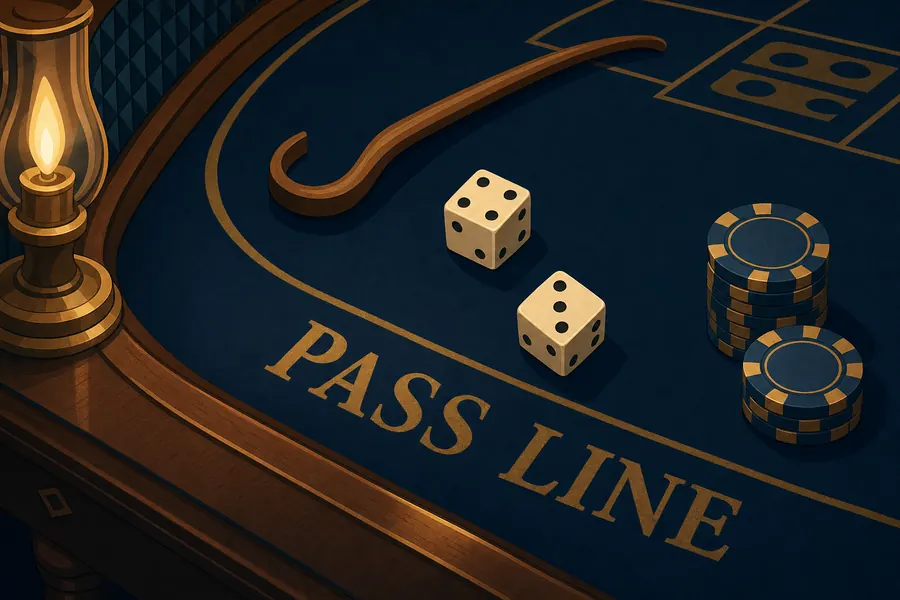
Pass Line, Odds, Field and Place 6 and 8, with the house edge printed beside every bet.
Modern · 5 min · practice chips
How it works One round of craps
The rules most players need, in five steps.
A round starts when the shooter throws two dice with no point set. If you have a bet on the Pass Line, a 7 or 11 wins at once and pays even money. A 2, 3 or 12, called craps, loses at once. Any other total, 4, 5, 6, 8, 9 or 10, becomes the point, and the dealer moves a puck onto that number.
Now the shooter keeps throwing until either the point or a 7 comes up. The point wins the Pass Line, a 7 loses it, and every other total changes nothing for that bet. Because 7 is the most likely total, a point of 4 or 10 is hard to make and a point of 6 or 8 is the easiest.
No point yet. The next roll is a come-out.
Sits on the point. Point wins, 7 loses.
Once the point is set you can place extra chips behind your Pass Line bet. This odds bet pays at the true chance of making the point: 2:1 on 4 and 10, 3:2 on 5 and 9, 6:5 on 6 and 8. It is the one bet in the casino with no house edge, which is why the guide spends a whole chapter on it.
Point 4 or 10
Odds pay2:1
Point 5 or 9
Odds pay3:2
Point 6 or 8
Odds pay6:5
The fewer ways to make the point, the more the odds pay. The house keeps nothing.
Come bets work like a second Pass Line bet started in the middle of a round. Don't Pass and Don't Come are the mirror bets that win when the shooter fails. Place bets let you back a single number without waiting, and the centre of the table holds one-roll bets with big payouts and the highest house edges in the game.
Every one of these rules is Hazard with the choices taken away. In Hazard the caster picked the main and the winning numbers moved with it. Craps fixed the main at 7 for everyone, which is why the come-out roll has the same results every time and why the table can deal to a dozen players at once.
Lineage Where craps comes from
Bernard de Marigny is usually credited with bringing Hazard to New Orleans; the losing throw "crabs" became the name. John H. Winn's 1907 layout added the Don't Pass bet and let the house bank every wager, which is the game casinos still deal.
In between, craps was a street and riverboat game played on blankets and pavements with no house at all, players betting against each other. That is why the language of the table is still full of nicknames: snake eyes for a 2, boxcars for a 12, yo for 11.
Where to play
Licensed casinos with live and online craps, checked for your province or country.
Questions and further reading
The answers new players ask for first.
The odds bet behind a Pass or Come bet. It pays at true odds, so the house edge is zero. You can only make it after a point is set, and only alongside a Pass or Come bet, which carries 1.41%.
No. Every throw is chance. Skill lies only in choosing bets with a low house edge and avoiding the centre-table bets, which run from 9% to 16.67%.
From Hazard, an English dice game recorded in the 14th century. It reached New Orleans around 1800 and was simplified there into the game we know.
On the first throw of a round, 7 or 11 wins the Pass Line, 2, 3 or 12 loses it, and any other total becomes the point. The shooter then throws until the point or a 7 comes up.
Yes, at the table on this page. It uses practice chips with no cash value.
 FamilyAll dice games
 AncestorHazard
 CousinSic Bo