Ancient GamesStone AgeXP 0

Play Hnefatafl: The Viking King's Game

Escape the king to a corner, or trap him on four sides.

11 × 11 · Corner escape · Copenhagen-style, simplified

How to play

Four moves to understand the game

  1. 1. Move in straight lines

    Every piece moves any number of empty squares, along a row or a column. No diagonals, no jumping.

  2. 2. Capture between two

    Move so an enemy sits between your piece and another of yours. The king helps capture.

  3. 3. Respect the throne

    Only the king may stop on the central throne or the corners. Others may pass the empty throne.

  4. 4. Reach a corner

    Defenders win when the king reaches a corner. Attackers win by surrounding him on four sides.

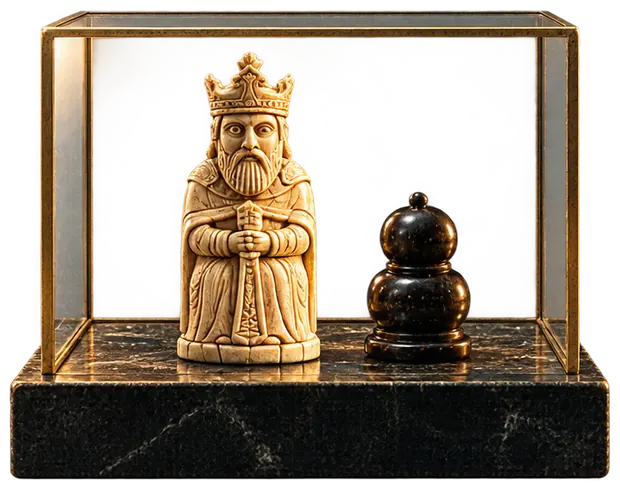
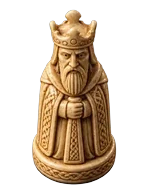
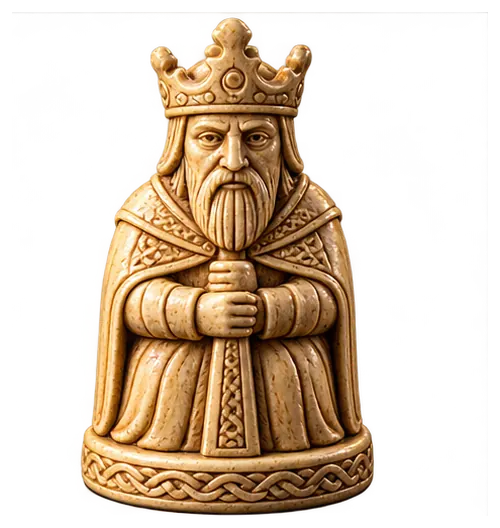
A carved bone king figure on a stone base
The king · carved bone

Before the checkmate

Where Hnefatafl comes from

Hnefatafl, "the king's table", is the best known of the tafl games the Norse and their neighbours played for roughly a thousand years before chess replaced them. It is an asymmetric battle: a king and twelve defenders start in the centre and try to reach a corner, while twenty-four attackers try to close the ring.

Tafl boards and gaming pieces turn up in Viking-age graves and settlements across Scandinavia, Britain and Ireland, and the word hnefatafl appears in Old Norse sagas. The rules, however, were never written down in full by the people who played. The best-known source is the Swedish naturalist Carl Linnaeus, who recorded a related game, Tablut, in Lapland in 1732.

Modern rule sets such as Copenhagen grew out of that record and decades of play by enthusiasts. They are a reconstruction: playable and balanced, but not proof of how a Viking played on a winter evening. The version on this page follows the Copenhagen rules, with a few simplifications listed below.

  • 11 × 11Board
  • 24Attackers
  • 12 + 1Defenders + king

The rules we use

  1. Attackers move first. Players alternate, one piece per turn.
  2. Every piece moves like a rook: any number of empty squares in a straight line, never diagonally and never jumping.
  3. Restricted squares. Only the king may stop on the throne in the centre or on the four corners. Other pieces may pass over the empty throne.
  4. Capture by moving a piece so that an enemy sits between it and another of your pieces, in a row or a column. The corners always count as hostile; the empty throne counts as hostile too. The king can help capture.
  5. Defenders win when the king reaches a corner.
  6. Attackers win when attackers stand on all four sides of the king (the throne can take the place of one), or when the defenders cannot move.

Simplified for this version: no shieldwall captures, no edge forts and no repetition rule. After 200 moves the game is a draw.
How to play well

The two sides want completely different things, and that is the whole charm of the game. The defenders are outnumbered two to one, but they only need one clear line from the king to a corner. The attackers have the numbers, yet every piece they send forward leaves a gap somewhere else.

Playing the defenders

As the defender, open lines early. Move a defender out of the way so the king can see along a row or a column, then threaten two corners at once: the attackers can only block one per move. Keep a few defenders close to the king, because a king standing alone in the open is easy to surround. Trades usually help you, since the attackers need their mass to build a wall.

Playing the attackers

As the attacker, think in walls, not in hunts. Chasing the king piece by piece rarely works. Instead, close the corners first by placing attackers on the squares next to them, then tighten the ring slowly from all four sides. Avoid leaving a single attacker between two defenders, and do not rush into the centre: a ring that is complete but wide beats one that is close but broken.

On this board, a good first goal is simple. Win once as the defender on Easy, then try Normal and count your moves. A win on Hard is worth 80 XP in the Arena, and Hnefatafl turns up in the daily challenges.

Tafl across the north

Hnefatafl was one member of a whole family. Boards of different sizes turn up across the Viking world: nine by nine Tablut in Lapland, eleven by eleven boards in Scandinavia, and larger variants such as Alea Evangelii, a nineteen by nineteen board described in a manuscript from Anglo-Saxon England. In Ireland and Wales the related games were called brandubh and tawlbwrdd.

What connects them is the shape of the battle rather than one fixed rulebook: a king and a small guard in the middle, a larger force around the edge, and pieces that move in straight lines. When chess reached northern Europe, it slowly took the place of tafl at the table, and the older game survived mainly in names, in finds from graves and in the record that Linnaeus wrote down.

Questions

Before your first move

Hnefatafl is simple to learn and full of subtle strategy. Here are answers to the questions new players ask most often.

Ready for the next game?

Take the king to a corner on Hard for +80 XP.

Back to the board

Is Hnefatafl older than chess?

Tafl games were played in northern Europe before chess arrived there around the 11th century, and chess then gradually replaced them. Chess itself is older: it began in India around the 6th century.

Which side is easier?

With Copenhagen rules the sides are close to balanced between strong players. Against this board, defending is usually the friendlier start.

Can the king capture?

Yes. In this version the king takes part in captures like any other defender.

How long does a game take?

Against this board most games end within ten to twenty minutes. A game between two careful human players can last much longer, because the attackers build their wall slowly.

Why are there different rules online?

Because no complete original rulebook survives, clubs and websites use different reconstructions. Copenhagen and Fetlar are the most common. They mostly differ in how the king is captured and how edges and corners work.

Continue the lineage

Games across time and cultures

Explore all games