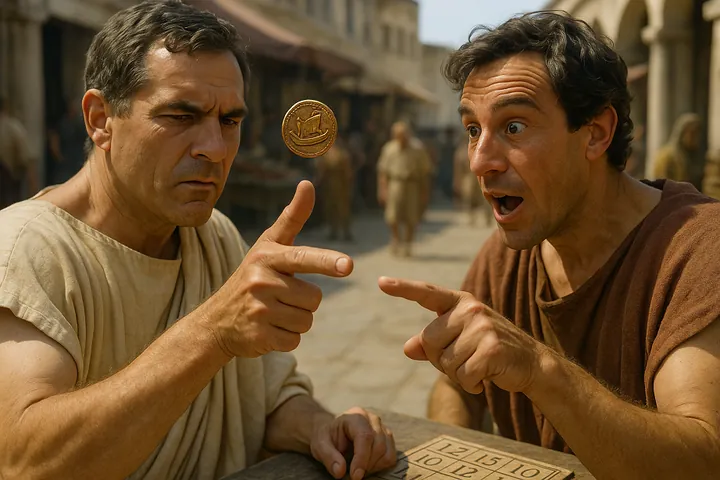
Navia aut Caput, usually translated as “Ship or Head,” is associated with Roman coin-tossing. It offers a simple comparison with modern wagers on uncertain outcomes. It is not an established ancestor of baccarat: choosing Player or Banker involves card rules and a possible tie, not a fair two-outcome coin toss.
The Simplest Game of Chance: Ship or Head
Macrobius describes children tossing coins and calling capita aut navia in Saturnalia 1.7.22. His account connects the words to head and ship imagery on coins. This is evidence for a coin-tossing custom, not for a connection to baccarat.
A coin toss needs little equipment: agree which face counts for each outcome and toss the coin. An ideal fair coin gives each face an equal chance, but fairness is a model assumption. The account cited here does not establish a universal Roman ruleset or participation by every social group.
The casino connection: comparing different kinds of wager
The useful comparison is how a simple choice can make a random event engaging. It does not establish direct historical descent. In baccarat, Player and Banker do not have identical probabilities and a tie is possible; in roulette, the zero pockets mean red and black do not exhaust the possible outcomes.
Compare the actual outcomes before treating these wagers as equivalent:
- Baccarat: Player and Banker are two common selections, but the dealt hands can also tie. Drawing rules and payout conditions make this different from a fair coin toss.
- Roulette: Red/black, odd/even and high/low are paired selections. A zero can lose both selections under standard rules. The resemblance to choosing a coin face does not establish historical descent.
From a Simple Flip to a Casino Empire
A choice can be easy to state even when the underlying outcomes and payouts differ. Understanding those differences is more useful than assuming that every paired selection has equal odds.
The appeal of predicting an uncertain event gives these games a point of comparison. It does not make their probabilities, rules or historical origins interchangeable.
Use the Roman example to ask what is being predicted and which outcomes are possible. Those questions transfer to other games even when their rules and histories differ.